International News

What is QUAD…??

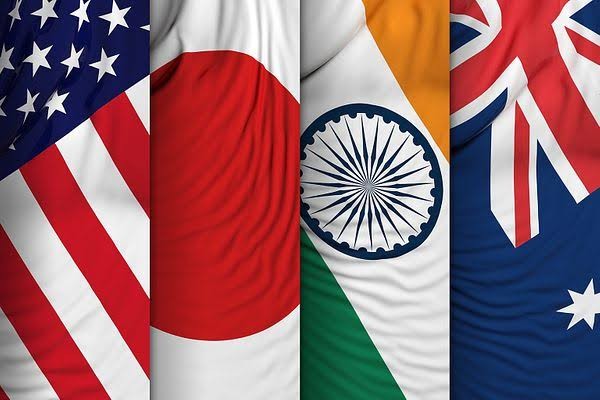
The Quadrilateral Security Dialogue (QSD), colloquially the Quad (sometimes erroneously written QUAD despite not being an acronym), is a strategic security dialogue between Australia, India, Japan, and the United States that is maintained by talks between member countries.

The Quad is a diplomatic network of four countries committed to supporting a free and open Indo-Pacific that is inclusive and resilient. It complements our other bilateral, regional and multilateral cooperation, including with ASEAN member states and Pacific partners.
Why was QUAD Formed ….?

Quad Formation: It was initiated in 2007 by Shinzo Abe, Japanese Prime Minister with the support of the Australian PM Johan Howard, the US Vice-President Dick Cheney and Man Mohan Singh, PM of India. It was aligned with a joint military exercise, titled Exercise Malabar

QUAD Significance

Details about why Quad is significant are given below:

  1. Quad has emerged from a mere security co-operation into the Quad Framework that includes: supply chain initiatives and collaboration in the emergence of critical technologies.
  2. India is central to the Quad framework visible from the term “Indo-Pacific” and has got a chance to showcase its capabilities to other nations.
  3. A major dialogue to counter the assertive role and dominance of China in the Indo-Pacific region and oppose them. It can influence other South-East nations for the same.

Quad Nations And China

USA: USA had followed a policy to contain China’s increasing influence in East Asia. Therefore, USA sees the coalition as an opportunity to regain its influence in the Indo-Pacific region.

The US has described China, along with Russia, as a strategic rival in its National Security Strategy, National Defence Strategy and the Pentagon’s report on Indo-Pacific Strategy.

Australia: Australia is concerned about China’s growing interest in its land, infrastructure and politics, and influence on its universities.

  • Taking into account its overwhelming economic dependence on China for prosperity, Australia has continued its commitment to a Comprehensive Strategic Partnership with China

Japan: In the last decade, Japan has expressed concerns related to China’s territorial transgression in the region.

  • Trade volume with China remains the key lifeline to the Japanese economy, where net exports contributed exactly one-third of Japan’s economic growth since the beginning of 2017.

Japan has also agreed to involve in the Belt and Road Initiative by participating in infrastructure programs in third country. In this way, Japan can mitigate Chinese influence in those countries while improving relations with China.

India: In recent years, China’s violation of international norms, particularly its construction of military facilities on reclaimed islands in the South China Sea, and its growing military and economic power, pose a strategic challenge to India.

  • Considering China’s strategic importance, India is carefully balancing China on one hand and the US on the other, by remaining committed to strategic autonomy to China, which has generally proved reassuring to China.
  • India has also not permitted Australia to participate in Malabar Trilateral Maritime exercises between India, US and Japan, concerned about what message it would send to China, which is wary of the exercise.
  • The recent Mamallapuram summit between President Xi Jinping and PM Modi is a positive development, valued by both sides as key to giving strategic guidance to stakeholders on both sides

Challenges

China’s Territorial Claims: China claims that it has historical ownership over nearly the entire region of South China Sea, which gives it the right to manufacture islands. However, the International Court of Arbitration rejected the claim in 2016

China’s Closeness to ASEAN: The ASEAN countries also have a well-knit relationship with China. The Regional Cooperation Economic Partnership (RCEP) is a recent example of China’s increasing influence over ASEAN nations

Economic Power of China: Considering the economic might of China and the dependence of Quad nations like Japan and Australia on China, the Quad nations cannot afford to have strained relations with it.

Convergence among Quad Nations: The nations in the Quad grouping have different aspirations, aims at balancing their own interest. Therefore, coherence in the vision of Quad nation as a grouping is absent.


National News

Article 142

Why in News ..?

Recently, the Supreme Court has invoked its extraordinary powers to do complete justice under Article 142 of the Constitution and ordered the release of A.G. Perarivalan in former prime minister Rajiv Gandhi Assassinated

  • The court protected federalism by holding that States had the power to aid and advice the Governor in case of pleas of pardon under Article 161 made by convicts in murder cases.
  • Article 161 provides that the Governor of a State shall have the power to grant pardons, reprieves, respites or remissions of punishment or to suspend, remit or commute the sentence of any person convicted of any offence against any law relating to a matter to which the executive power of the State extends

What is the Supreme Court Rulling

  • Tamil Nadu Council of Ministers’ advice in 2018 to pardon Perarivalan was binding on the Governor under Article 161 (Governor’s power of clemency) of the Constitution.
  • The Governor’s reluctance to take a call on the pardon plea has compelled the court to employ its constitutional powers under Article 142 to do justice to Perarivalan.
  • The Supreme Court used Article 142 of the Constitution that grants it extraordinary powers to do complete justice, to release Perarivalan.
  • The court dismissed the Centre’s argument that the President exclusively, and not the Governor, had the power to grant pardon in a case under Section 302 (murder) of the Indian Penal Code saying this contention would render Article 161 a “dead-letter” and create an extraordinary situation whereby pardons granted by Governors in murder cases for the past 70 years would be rendered invalid.

What is Article 142..?

Article 142 “provide(s) a unique power to the Supreme Court, to do “complete justice” between the parties, i.e., where at times law or statute may not provide a remedy, the Court can extend itself to put a quietus to a dispute in a manner which would befit the facts of the case.

What are the important instances where the Supreme Court has invoked its plenary powers under Article 142

Article 142(1) states that “The Supreme Court in the exercise of its jurisdiction may pass such decree or make such order as is necessary for doing complete justice in any cause or matter pending before it, and any decree so passed or order so made shall be enforceable throughout the territory of India in such manner as may be prescribed by or under any law made by Parliament and, until provision in that behalf is so made, in such manner as the President may by order prescribe”.

Manohar Lal Sharma v. Principal Secretary- the Supreme Court can deal with exceptional circumstances interfering with the larger interest of the public in order to fabricate trust in the rule of law.

A.R. Antulay v. R.S. Nayak– the Supreme Court held that any discretion which is given by the court should not be arbitrary or in any way be inconsistent with provisions of any statute laid down

Laxmi Devi v. Satya Narayan- Supreme Court had ordered the accused, under Article 142, to award compensation to the victim with whom he had sexual intercourse with a promise to marry and had later retracted his promise. Also, the order made clear that the accused should not be convicted of rape

Union Carbide Corporation v. Union of India– In Bhopal Gas Tragedy Case, the court ordered to award compensation to the victims and placed itself in a position above the Parliamentary laws

What are some other popular instances where the Supreme Court has used its power under Article 142?

Manipur Speaker Case- Keisham Meghachandra Singh v. Hon’ble Speaker, Manipur Legislative Assembly.

Divorce On The Ground Of Irretrievable Breakdown Of Marriage- Munish Kakkar v. Nidhi Kakkar.

Advantages of Article 142

  • Whenever the executive or legislature fails to defend people’ rights and uphold constitutional ideals, the judiciary has used its powers under Article 142 to do so.
  • As the constitutional protector, Article 142 gives it the capacity to fill statutory gaps.
  • It also establishes a system of checks and balances for the government’s other branches.For instance:
    • The Supreme Court established norms to safeguard a woman from sexual harassment at work in the case of Vishakha v State of Rajasthan.
    • In the Bandhua Mukti Morcha Case, the Supreme Court of India handed down a landmark verdict on India’s bonded labour system.
    • In the case of Olga Tellis, the right to subsistence was held to be an integral aspect of the right to life.

Disadvantages of Article 142

  • Unaccountable: One of the drawbacks of the Supreme Court’s powers under Article 142 has been that, unlike the executive and legislature, it can’t be made accountable for its verdicts.
    • In one of the rulings, for example, the highest court outlawed e-rickshaws in specific sections of Delhi without providing alternatives. It cannot, however, be held liable for infringing on the basic right to engage in any profession or business.
  • Judicial Under-reach: The issue of judicial under-reach develops when courts, despite possessing jurisdiction, shirk their obligations, leading to injustice.
    • The majority of petitions/appeals brought before the Supreme Court via Article 136 of the Indian Constitution are rejected, although the court’s justices are not required to explain why.
  • Public faith in the government’s integrity, quality, and efficiency can be eroded by frequent court interference.

National and Internation

Topic : Covid 19 Challenges and Lockdown

Introduction

The best defense against any outbreak in the world is a strong health system. The COVID-19 pandemic has caused
a strain on the healthcare systems of all the countries across the world. The rapidly increasing demand on health
facilities and health care workers threatens to leave the health systems overstretched and unable to operate
effectively.
Like other nations, India is also building its arsenal to fight the COVID-19 battle. India’s response has scored a 100
on the Oxford COVID-19 Government Response Tracker (OxCGRT), that aims to track and compare government
responses to the coronavirus outbreak worldwide, rigorously and consistently. But with the number of confirmed
cases reaching 39,980
as on 3rd May, 2020 and death toll reaching more than 1300, Indian healthcare system has a
challenging task at its hand. All the stakeholders are joining the growing battalion of COVID warriors from the
bureaucrats, health professionals, entrepreneurs, regulators like ICMR among others.
In this background, this report analyses the preparedness of India’s health care system on two main parameters
i.e. current status and challenges faced in the three broad domains of governance, infrastructure and technology.
It tries to analyze different approaches which India has adopted and the gaps which remain to fight the COVID-19
battle effectively.

GOVERNANCE

Organisation of Health System

Organisation of Health System￾India has a four tier structure of
governing health services in the
country at the following levels￾National, State, District and Block
level. The situation at district and local
level is-
• District wise- segregation- With a
view to managing to COVID-19,
every district of the country has
been divided into:
Hotspot districts, Non-Hotspot
districts with reported cases,
Green zone districts.
• Gram Sabhas are organizing
awareness drives regarding clinical
presentation of the novel CoV
diseases, preventive measures, and
the need for reporting especially in the villages in border districts

Regulation and Guidelines

The government has come up with multiple guidelines to regulate the conduct and use of equipment in the fight
against COVID-19, such as-
• The national guidelines on surveillance, case investigation and laboratory detection of COVID-19 cases.
• The national guidelines on blood transfusions and voluntary blood donation to ensure adequate stocks of
blood & blood components
• Grievance Redressal- An exclusive window was introduced for COVID related grievances on the National
Monitoring Dashboard (https://darpg.gov.in).
o Due to the prompt and round-the-clock follow up, the average disposal time of a grievance has come
down to 1.57 days

Health Expenditure

The most important lesson India has to learn during the present pandemic as well as the past pandemics is
that investing in preparedness can cost little and could save millions of lives.
o Funds earmarked to strengthen
pandemic preparedness plans are
reduced or diverted. The National
Health Policy of India (2017)
articulates increasing investment
in health to 2.5 per cent of the
national gross development
product (GDP) by 2025 from a
meagre 1.15 per cent in 2017.
o High out of pocket expenditure- About 65% of all health expenditure in India (~ 2.5% of GDP) is borne
privately by households.
o Lowest spending on preventive care- As proportion of all healthcare functions (Refer to the infographic)
• Capacity of the national regulatory authority- in promoting indigenous production of equipment, reagents
and other materials and instituting fast-track approval processes for indigenous and imported material and
equipment are needed for responding to the epidemics

INFRASTRUCTURE

Hospitals

Cumulatively, 2144 dedicated COVID-19 hospitals have been identified at both Centre and State level which
includes:

• 755 Dedicated COVID Hospitals (DCH) (with 107830 isolation beds and 14742 ICU beds)- for severe & critical
cases with ventilator support.
• 1389 Dedicated COVID Health Centres (DCHC) (with total of 65916 isolation beds and 7064 ICU beds)- for
clinical moderate cases requiring oxygen support

Health Professions

As per the Government of India, around 1.25 crore
corona warriors are available in the country and
working towards fighting the menace in different
capacities. The numbers of some of these warriors
have been depicted in the infographic.
• Following steps have been taken in this
direction￾o Database- a portal i.e.
covidwarriors.gov.in has been created as a
master database of healthcare
professionals and volunteers.
o Capacity Building Initiatives-
✓ iGOT e-learning Platform- Launched
by Department of Personnel and
Training, it is a digital platform to train all healthcare and COVID-19 warriors of Indiaiii
.
✓ Training Resources- Online training modules and webinars for ventilator management, clinical
management, infection prevention control, bio-medical waste management, and epidemiology have
been organized.
o Sentinel surveillance- Since February 15, ICMR has initiated sentinel surveillance to detect community
transmission of COVID19.

National and International News

(1) Sex as Work

Context The Supreme Court has passed an order stating that adult sex workers are entitled to dignity and equal protection under the law

  • The apex court, in a landmark decision, has directed the police to respect the rights of consenting sex workers upholding the provisions of the right to a dignified life as enshrined under Article 21 of the Constitution. 
  • This has been a long-standing demand of the sex workers to get their work decriminalised. 
  • The court echoed the verdict of the Budhadev Karmakar case that confers on sex workers, the right to live with dignity. 
  • The Court exercised powers under Article 142 to issue guidelines to recognise the rights of sex workers and to prevent human trafficking till a legislative safeguard is enforced. 
  • The court has put significant efforts to encourage the government in giving effect to the Trafficking (Prevention, Protection and Rehabilitation) Bill. 

The court’s Directive

  • The Supreme Court has asked for the government’s response to the decision of recognising the rights of sex workers within a period of six weeks. 
  • The court has conveyed its determination to uphold the basic protections of human decency and the extension of dignity to sex workers and their children. 
  • The state governments have been asked to conduct a survey of protective homes under the Immoral Traffic Prevention Act which exemplifies legislation governing sex work in India. This law penalises acts such as running a brothel, soliciting in a public place, living off the earnings of a sex worker and living with or habitually being in the company of one

Road to a compassionate society

  • The Supreme Court’s order must ignite a sense of compassion in the civilised society we live in and facilitate the police, media and people to rise above all narrowness and head towards a transformative journey. 
  • Such a transformed society must recognise the rights of every individual including the sex workers and protect the dignity of all. 
  • Therefore, it depends considerably on the government to formulate legislation for protecting the legitimate interests of the consenting sex workers, free them from societal stigmas, offer proper health security benefits to prevent the transmission of Sexually Transmitted Diseases, and engage them in the law-making process

Chemistry

Chapter 1

Chemical Reactions And Equations

Some Important Headings and Its Defination with Example

1. Chemical Reaction

A chemical reaction is the process by which reactants react with each other to yield products. In chemical reactions, the reactant molecules are completely different from the molecules of the products formed.

Example

Hydrogen gas reacts with oxygen gas to form Water as product

2. Chemical Equation

A chemical Equation is a written Representation of a Chemical Reaction

Types of Chemical Reactions

There 4 types of chemical Reactions which are given below

(1) Combination Reaction

A combination reaction is a reaction where two or more elements or compounds combine to form a single compound. Such reactions are represented by equations of the following form:

Example

Magnesium reacts with Oxygen to form Magnesium Oxide

2Mg + O2 ————–> 2MgO

Combination Reaction is Also Known As Synthesis Reaction.

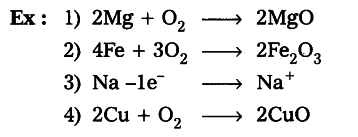
Some more example of Combination Reaction

2. Decomposition Reaction

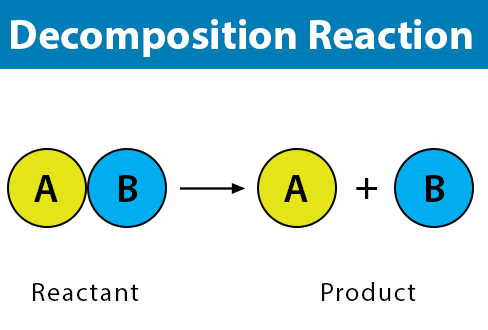
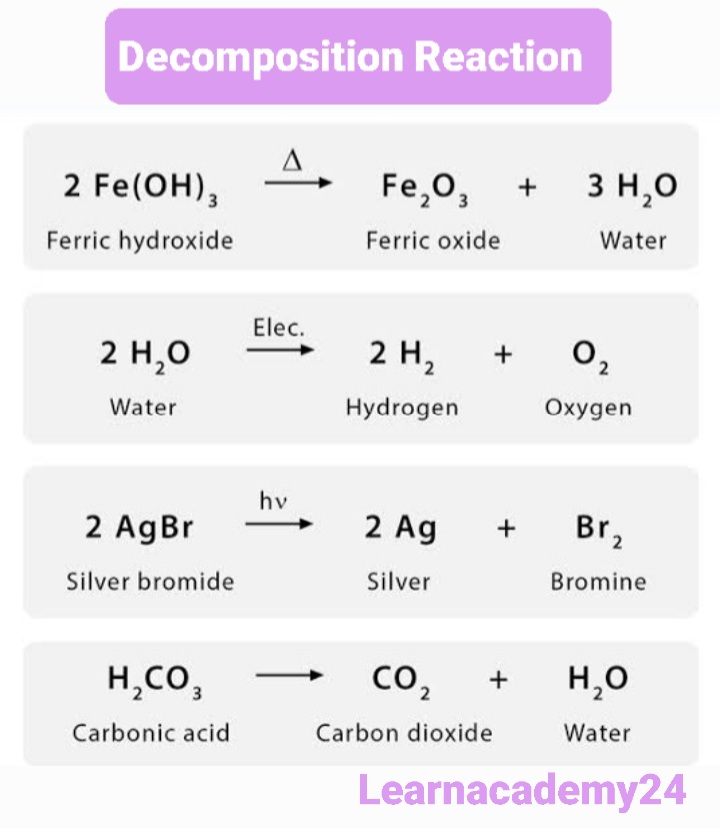
Decomposition is a type of chemical reaction.  It is defined as the reaction in which a single compound splits into two or more simple substances under suitable conditions

Example

Breaking of Sodium Chloride into Sodium and Chlorine

Nacl ————–> Na+Cl

Some more Example of Decompostion Reaction

Note:- The Decomposition Reaction May be Either Exothermic or Endothermic.for Example

  • The decomposition of NO to N2 & O2 is exothermic.
  • Decomposition of ozone (O3) to oxygen (O2) is exothermic.

3. Displacement Reaction

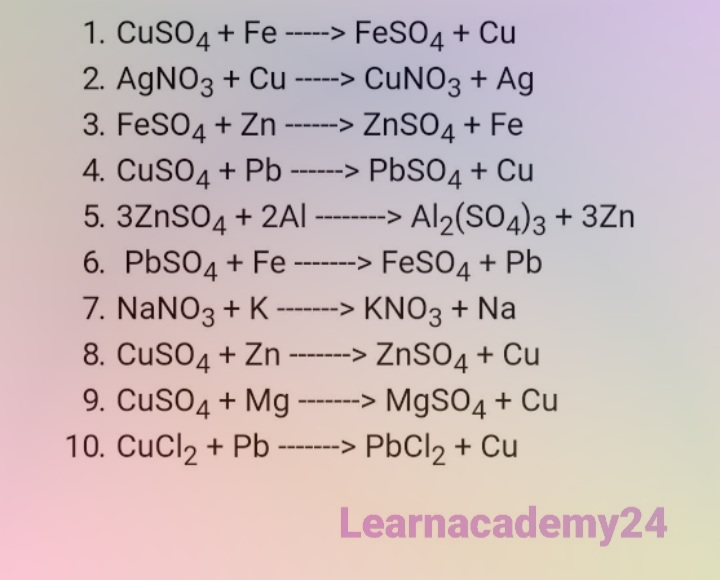
Single displacement reactions are reactions where one reactant replaces part of the other:

AB + C → AC + B

An example is the reaction between iron and copper sulfate to produce iron sulfate and copper:

Fe + CuSO4 → FeSO4 + Cu

Some more Example of Displacement Reaction

4. Double Displacement Reaction

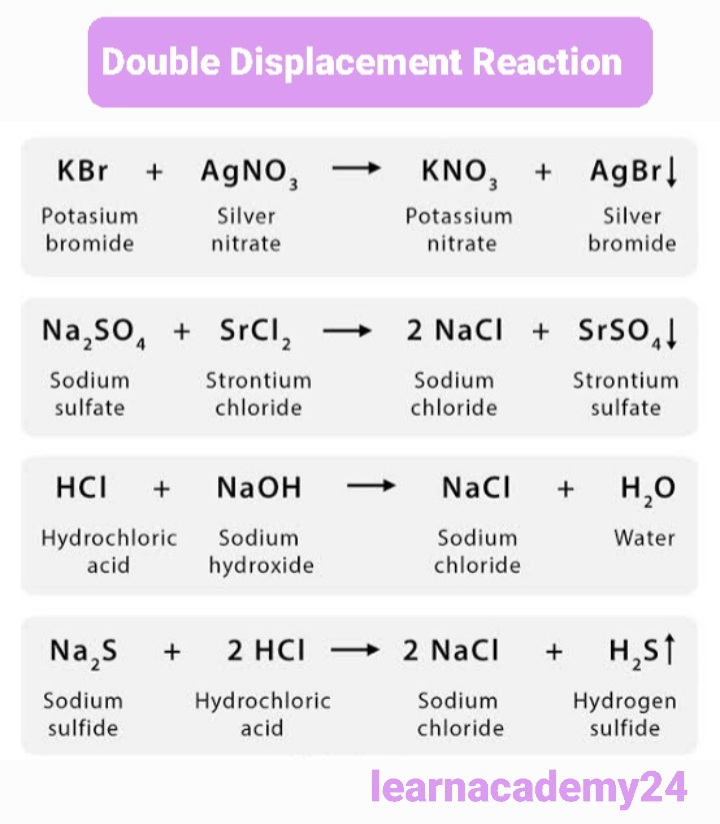
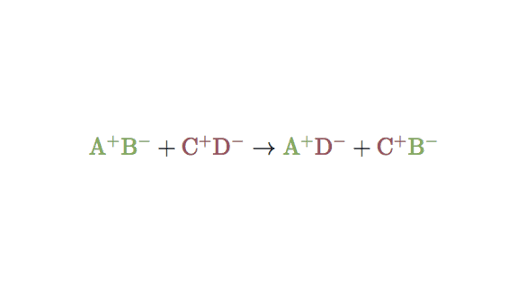
Those reactions in which two compounds react by an exchange of ions to form two new compounds are called double displacement reactions. In double replacement reactions, the positive ions exchange negative ion partners. Many double displacement reactions occur between ionic compounds that are dissolved in water. A double replacement reaction is represented by the general equation

We can write as

Example

AB+CD ———-> AD+BC

Example

BaCl2 +2AgNO3 ——— 2Agcl +Ba( NO3 ) 2

Some more Example of Double Displacement Reaction

* Oxidation

The Addition of oxygen to a substance or removal of Hydrogen from a substance know as oxidation.

Example

2Mg + O2 ——— 2MgO

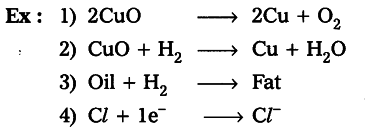
* Reduction

The removal of Oxygen from a substance or Addition of hydrogen to a substance known as Reduction

Example

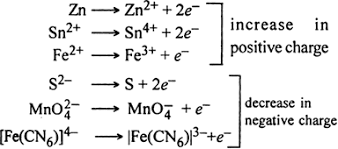
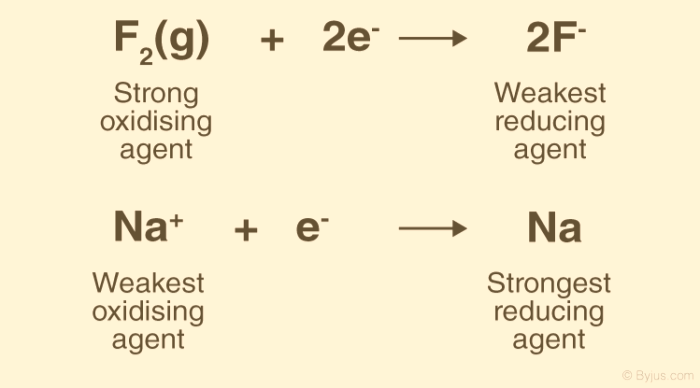
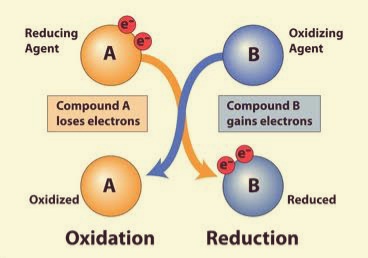
Reducing Agent

A substance which loses electrons to other substances in a redox reaction and gets oxidized to the higher valency state is called a reducing agent

Example

Oxidising Agent

An oxidizing agent is a substance in a redox chemical reaction that gains or “accepts”/”receives” an electron from a reducing agent. In other words, an oxidizer is any substance that oxidizes another substance

Example

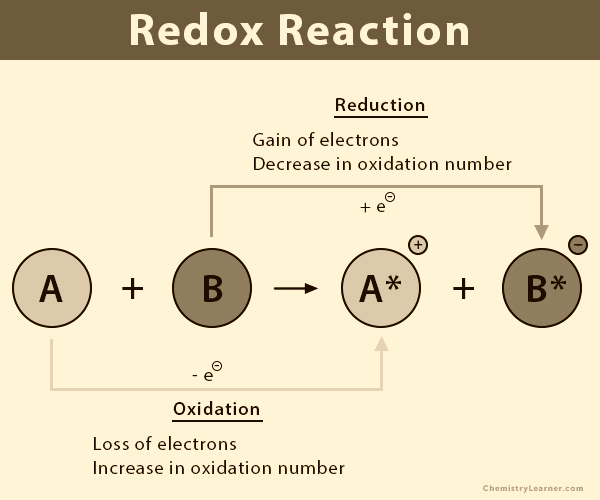
Redox Reaction

An oxidation-reduction (redox) reaction is a type of chemical reaction that involves a transfer of electrons between two species. An oxidation-reduction reaction is any chemical reaction in which the oxidation number of a molecule, atom, or ion changes by gaining or losing an electron. Redox reactions are common and vital to some of the basic functions of life, including photosynthesis, respiration, combustion, and corrosion or rusting

Example

Exercise 1.1(NCERT Book)

Question – 1: Use Euclid’s division algorithm to find the HCF of:

(i) 135 and 225 (ii) 196 and 38220 (iii) 867 and 255

(i) By Euclid’s Division Algorithm, we have
225 = 135 x 1 + 90 135
= 90 x 1 + 45 90
= 45 x 2 + 0
∴ HCF (135, 225) = 45

(ii)By Euclid’s Division Algorithm, we have
38220 = 196 x 195 + 0
196 = 196 x 1 + 0
∴  HCF (38220, 196) = 196

(iii)    867 and 255
Step 1: Since 867 > 255,
apply Euclid’s division lemma, to a =867 and b=255 to find q and r
such that 867 = 255q + r, 0 ≤ r<255
On dividing 867 by 255 we get quotient as 3 and remainder as 102
i.e 867 = 255 x 3 + 102

Step 2: Since remainder 102 ≠ 0,
we apply the division lemma to a=255 and b= 102 to find whole numbers q and r
such that 255 = 102q + r where 0 ≤ r<102
On dividing 255 by 102 we get quotient as 2 and remainder as 51
i.e 255 = 102 x 2 + 51

Step 3: Again remainder 51 is non zero,
so we apply the division lemma to a=102 and b= 51  to find whole numbers q and r
such that 102 = 51 q + r where 0  r < 51
On dividing 102 by 51 quotient is 2 and remainder is 0
i.e 102 = 51 x 2 + 0
Since the remainder is zero, the divisor at this stage is the HCF
Since the divisor at this stage is 51,therefore, HCF of 867 and 255 is 51.

Question 2:
Show that any positive odd integer is of the form 6q + 1, or 6q + 3, or 6q + 5, where q is some integer.

Solution:
Let ‘a’ be any positive integer and b = 6.
∴ By Euclid’s division algorithm, we have
a = bq + r, 0 ≤ r ≤ b
a = 6q + r, 0 ≤ r ≤ b [ ∵ b = 6] where q ≥ 0 and r = 0,1, 2, 3, 4,5
Now, ‘a’ may be of the form of 6q, 6q + 1, 6q + 2, 6q + 3, 6q + 4, 6q + 5
If ‘a’ is of the form 6q, 6q + 2, 6q + 4 then ‘a’ is an even

In above we can see clearly that the numbers of the form 6q, 6q + 2, 6q + 4 are having the factor 2.
∴ The numbers of the form 6q, 6q + 2, 6q + 4 are even

If ‘a’ is of the form 6q +1,6q +3, 6q + 5 then ‘a’ is an odd

We know that the number of the form 2k + 1 is odd.
∴ The numbers of the form 6q + 1, 6q + 3, 6q + 5 are odd.
Alternatively:
Let a be any odd positive integer we need to prove that a is of the form 6q + 1 , or  6q + 3 , or 6q + 5 , where q is some integer. Since a is an integer consider b = 6 another integer applying Euclid’s division lemma
we get a = 6q + r  for some integer q ≤ 0, and r = 0, 1, 2, 3, 4, 5  since
0 ≤ r < 6.
Therefore, a = 6q or 6q + 1 or 6q + 2 or 6q + 3 or 6q + 4 or 6q + 5
However since a is odd so a cannot take the values 6q, 6q+2 and 6q+4
(since all these are divisible by 2)
Also, 6q + 1 = 2 x 3q + 1 = 2k1 + 1, where k1 is a positive integer
6q + 3 = (6q + 2) + 1 = 2 (3q + 1) + 1 = 2k2 + 1, where k2 is an integer

6q + 5 = (6q + 4) + 1 = 2 (3q + 2) + 1 = 2k3 +  1, where k3 is an integer

Clearly, 6q + 1, 6q + 3, 6q + 5 are of the form 2k + 1, where k is an integer.
Therefore, 6q + 1, 6q + 3, 6q + 5 are odd numbers.
Therefore, any odd integer can be expressed is of the form
6q + 1, or 6q + 3, or 6q + 5 where q is some integer

Question 3:
An army contingent of 616 members is to march behind an army band of 32 members in a parade. The two groups are to march in the same number of columns. What is the maximum number of columns in which they can march….?

Let n be the number of columns such that the value of n be maximum and it must divide both the numbers 616 and 32.
Then, n = HCF (616, 32)
By Euclid’s Division Algorithm, we have:
616 = 32 x 19 + 8 32 = 8 x 4 + 0
∴ HCF (616, 32) = 8
i. e., n = 8
Hence, the maximum number of columns is 8

Question 4:
Use Euclid’s division lemma to show that the square of any positive integer is either of the form 3m or 3m + 1 for some integer m.
[Hint : Let x be any positive integer then it is of the form 3q, 3q + 1 or 3q + 2. Now square each of these and show that they can be rewritten in the form 3m or 3m + 1.]

Solution:
Let ‘a’ be any positive integer and b = 3.
∴ By Euclid’s division algorithm, we have a = 3q + r, 0 ≤ r < b
a = 3q + r, 0 ≤ r < 3 [ ∵ b = 3] where q ≥ 0 and r = 0,1, 2
∴ a = 3q or 3q + 1 or 3q + 2

Thus, the square of any positive integer is either of the form 3m or 3m + 1.
Alternatively:
Let a be a positive integer, q be the quotient and r be the remainder.
Dividing a by 3 using the Euclid’s Division Lemma,
we have:
a = 3q + r, where 0 ≤ r < 3
Putting r = 0, 1 and 2, we get:
a = 3q
⇒ a2 = 9q2
= 3 x 3q2
= 3m (Assuming m = q2)
Then, a = 3q + 1
⇒  a2 = (3q + l)2 = 9q2 + 6q + 1
= 3(3q 2 + 2q) + 1
= 3m + 1 (Assuming m = 3q2 + 2q)
Next, a = 3q + 2
⇒ a2 = (3q + 2)2 =9q2 + 12q + 4
= 9q2 + 12q + 3 + 1

= 3(3q2 + 4q + 1) + 1
= 3m + 1.   (Assuming m = 3q2 + 4q+l)
Therefore, the square of any positive integer (say, a2) is always of the form 3m or 3m + 1.
Hence, proved.

Question 5:
Use Euclid’s division lemma to show that the cube of any positive integer is of the form 9m, 9m + 1 or 9m + 8

Solution:

Let ‘a’ be any positive integer and b = 3.
∴ By Euclid’s division algorithm, we have a = bq + r,0 ≤ r ≤ b
a = 3q + r,0 ≤ r < 3 [ ∵ b = 3] where q ≥ 0 and r = 0. 1, 2
∴ a = 3q or 3q + 1 or 3q + 2

Thus, the cube of any positive integer is of the form 9m, 9m + 1 or 9m + 8.

Thank you

Real Numbers

Euclid Division Alogrith

Euclid’s division algorithm is a way to find the HCF of two numbers by using Euclid’s division lemma. It states that if there are any two integers a and b, there exists q and r such that it satisfies the given condition a = bq + r where 0 ≤ r < b.

The basis of the Euclidean division algorithm is Euclid’s division lemma

Consider two numbers 78 and 980 and we need to find the HCF of these numbers. To do this, we choose the largest integer first, i.e. 980 and then according to Euclid Division Lemma, a = bq + r where 0 ≤ r < b;

980 = 78 × 12 + 44

Now, here a = 980, b = 78, q = 12 and r = 44.

Now consider the divisor 78 and the remainder 44, apply Euclid division lemma again.

78 = 44 × 1 + 34

Similarly, consider the divisor 44 and the remainder 34, apply Euclid division lemma to 44 and 34.

44 = 34 × 1 + 10

Following the same procedure again,

34 = 10 × 3 + 4

10 = 4 × 2 + 2

4 = 2 × 2 + 0

As we see that the remainder has become zero, therefore, proceeding further is not possible. Hence, the HCF is the divisor b left in the last step. We can conclude that the HCF of 980 and 78 is 2.

Let us try another example to find the HCF of two numbers 250 and 75. Here, the larger the integer is 250, therefore, by applying Euclid Division Lemma a = bq + r where 0 ≤ r < b, we have

a = 250 and b = 75

⇒ 250 = 75 × 3 + 25

By applying the Euclid’s Division Algorithm to 75 and 25, we have:

75 = 25 × 3 + 0

As the remainder becomes zero, we cannot proceed further. According to the algorithm, in this case, the divisor is 25. Hence, the HCF of 250 and 75 is 25.

How does Euclid algorithm calculate HCF?

To obtain the HCF of two positive integers, say c and d, with c > d, follow the steps given below:
Step 1 : Apply Euclid’s division lemma, to c and d. So, we find whole numbers, q and r such that c = dq + r, 0 ≤ r < d.
Step 2 : If r = 0, d is the HCF of c and d. If r ≠ 0, apply the division lemma to d and r.
Step 3 : Continue the above steps till we get the remainder is zero. The divisor at this stage will be the required HCF.

Some Examples Based on Euclid Division algorithm

Q-1 Find the HCF of 81 and 675 using the Euclidean division algorithm

Solution: The larger integer is 675, therefore, by applying the Division Lemma a = bq + r where 0 ≤ r < b, we have

a = 675 and b = 81

⇒ 675 = 81 × 8 + 27

By applying Euclid’s Division Algorithm again we have,

81 = 27 × 3 + 0

We cannot proceed further as the remainder becomes zero. According to the algorithm, in this case, the divisor is 27. Hence, the HCF of 675 and 81 is 27.

Q-2 What is the HCF of 225 and 867?

867 is greater than 225
Applying Euclid’s division algorithm,
867 = 225 × 3 + 192
225 = 192 × 1 + 33
192 = 33 × 5 + 27
33 = 27 × 1 + 6
27 = 6 × 4 + 3
6 = 3 × 2 + 0
Therefore, HCF(867, 225) = 3.

Q-3 What is the HCF of 196 and 38220 ?

38220 is greater than 196.
Applying Euclid’s division algorithm,
38220 = 196 × 195 + 0
Therefore, the HCF of 196 and 38220 is 196

Q-4 What is the HCF of 4052 and 12576?

12576 is greater than 4052.
Applying Euclid’s division algorithm,
12576 = 4052 × 3 + 420
4052 = 420 × 9 + 272
272 = 148 × 1 + 124
148 = 124 × 1 + 24
124 = 24 × 5 + 4
24 = 4 × 6 + 0
Therefore, the HCF of 4052 and 12576 is 4

Thank you

Design a site like this with WordPress.com
Get started