

Swadeshi Movement (1905-1911)
Background
- The movement had its roots in the anti-partition movement which was started to oppose Lord Curzon’s decision of dividing the province of Bengal.
- The Anti-Partition Campaign was launched by Moderates to exert pressure on the government to prevent the unjust partition of Bengal from being implemented.
- The petitions were written to the government, public meetings were held and the ideas were spread through newspapers such as Hitabadi, Sanjibani and Bengalee.
- The partition led to protest meetings in Bengal under which the pledge to boycott foreign goods was first taken
Swadeshi Movement Proclamation
- The formal proclamation of the Swadeshi movement was made on August 7, 1905 with the passing of the ‘Boycott’ resolution in a meeting at the Calcutta town hall which brought about the unification of the hitherto dispersed leadership
- The message was propagated to boycott goods such as Manchester cloth and Liverpool salt
- On the day the partition was put into effect i.e. October 16, 1905, a hartal was called in Calcutta and a day of mourning was declared. People fasted and no fire was lit in the cooking hearth.
- People paraded the streets singing Bande Mataram. The people of Bengal tied rakhis on each others’ wrist as a symbol of solidarity
- Rabindranath Tagore also composed Amar Sonar Bangla
- Although the movement was confined majorly to Bengal, it spread to a few different parts of India:
- In Poona and Bombay under Bal Gangadhar Tilak
- In Punjab under Lala Lajpat Rai and Ajit Singh
- In Delhi under Syed Haider Raza
- In Madras under Chidambaram Pillai
- This peculiar form of mass protest of ‘swadeshi and boycott’ attained popularity among the new members of the Congress, who were more impatient than the moderates to see a positive response to their efforts
Congress Reaction
- The Indian National Congress (INC) in a meeting in 1905 resolved to condemn the partition of Bengal and support the anti-partition and Swadeshi Movement.
- The radical nationalists wanted the movement to be taken outside Bengal and go beyond just the boycott of foreign goods.
- However, the moderates, dominating the Congress, were unwilling to go that far.
- In the 1906 Congress Session held at Calcutta, the INC under the presidentship of Dadabhai Naoroji declared self-government or Swaraj as the goal of INC
Swadeshi Movement Effect
- This was a comprehensive movement that lasted 6 years.
- The swadeshi movement assumed its radical and mass form after 1905 following the contested spatial partition of Bengal.
- In 1907, swadeshi was officially incorporated within the conceptual and ideological framework of the Indian National Congress in the avowed objective of swadeshi swaraj.
- Although this was regarded as a cultural movement celebrating the rich harvest of history – the rich traditions like folk music, paintings, the culture of Bengal was highlighted. But very soon, it got integrated with the political upheavals that followed after the partition of Bengal. Krishna Kumar Mitra, in his newspaper, ‘Sanjivani’ highlighted the prospects of national education and ‘Economic Swadeshi’.
- Very soon, this movement started gaining momentum with the help of the entire Bengali middle-class intelligentsia.
- After the partition of Bengal, the Swadeshi movement got a big boost, because of the integration of the boycott movement with the Swadeshi movement.
- Tilak called this movement “Bahishkar Yoga“ and most of the Bengali intelligentsia that was initially not in favour of the boycott movement got integrated with the Swadeshi movement.
- This was primary learning for the national movement. According to Bal Gangadhar Tilak, and Lala Lajpat Rai, it was training in ‘self-determination’, ‘self-help’, and ‘self-reliance’.
- Initially the idea of swadeshi figured in the writings of early nationalists such as Dadabhai Nauroji, M.G.Ranade and Bipin Chandra Pal, who came in defence of the national economy against the colonial economy.
- In fact, the Swadeshi movement can be called as a nursery of the further course that the Indian National Movement was to take. The programmes and ideas that were practised during the Swadeshi movement became the hallmark of the Gandhian movement as well.
- Surendranath Bannerjee said that it is a ‘protectionist movement’. And that it ‘generates the material prosperity of the masses’.
- Very soon, the Swadeshi movement spread to different parts of India, like Bihar, U.P., C.P., Bombay and Madras.
- Radicalism also became a part of the Swadeshi movement after the partition of Bengal. After the partition of Bengal, industrial strikes became the hallmark of the Swadeshi movement.
- There were strikes carried out in various cotton and jute factories of Bengal. Railway workers also went on strike. The Burnpur mill also went on strike.
- But, the context of the anti-partition movement made it a very aggressive movement
Participation of People
- Students: School and college students were the most active participants of the movement.
- Student participation was visible in Bengal, Poona (Maharashtra), Guntur (Andhra Pradesh), Madras and Salem (Tamil Nadu).
- The police adopted a repressive attitude towards the students. The students found guilty were fined, expelled, beaten, arrested and disqualified for government jobs and scholarships.
- Women: Traditionally home-centered women too took active part in the movement.
- Stand of Muslims: Some of the muslims participated, however, most of the upper and middle class muslims stayed away.
- They supported the partition on the belief that it would provide them a Muslim-majority East Bengal
Problems with Swadeshi Movement
- But the problem with the Swadeshi movement was that it was not properly directed and it failed to unite the Hindus and Muslims because of the work of Nawab Salimullah of Dhaka and the establishment of the Muslim league.
- The demand of separate electorates became an issue to seek political mileage for the Muslims. Thus, the Swadeshi movement lacked having a large mass-base. The grievances of the peasants were not at all taken into consideration- such as lack of uniformity of the land revenue system, rights of the tenants, prevention of land grabbing, were not taken up by the Swadeshi movement, and thus the peasants did not become a part of the Swadeshi movement
Thank you
Never Give Up
RIP
National News
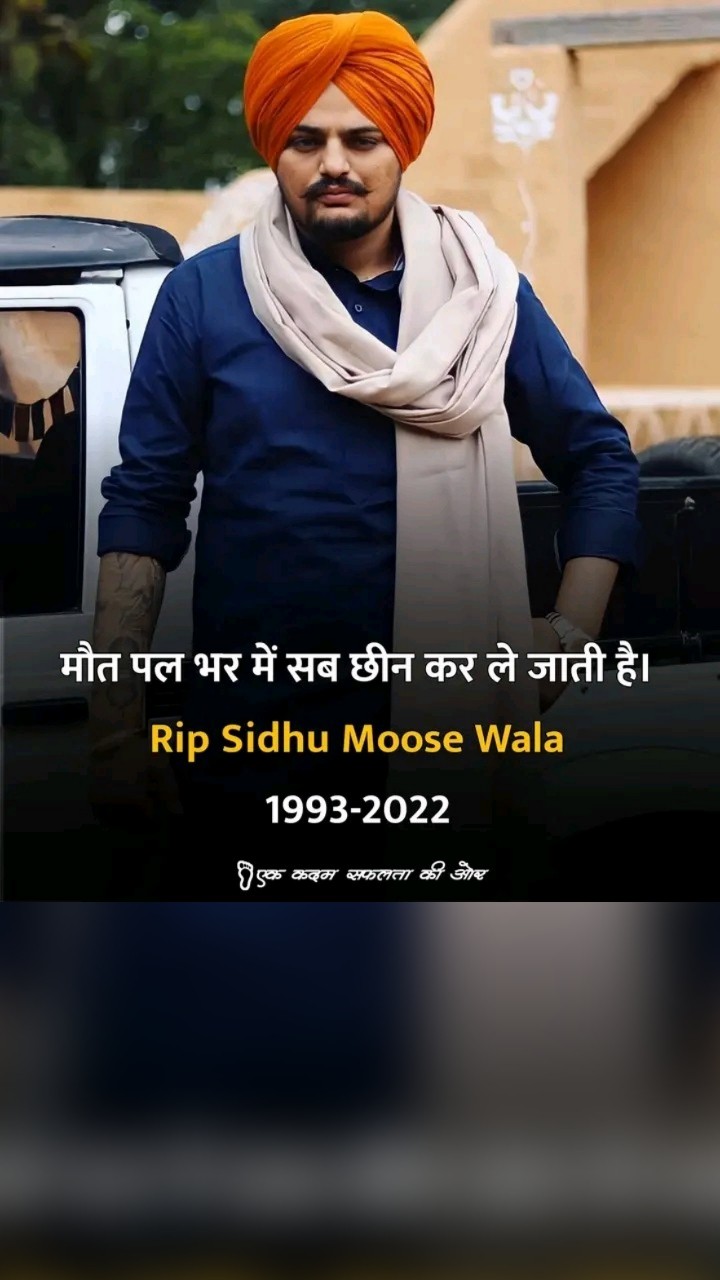
Sidhu Moose Wala Shot Dead
Popular singer and Congress leader Sidhu Moose Wala was shot dead in Punjab on Saturday. The Punjabi singer was on way to his village in Mansa when unidentified gunmen sprayed his SUV with bullets. He died later at a hospital.
The incident took place a day after the Punjab government withdrew his security cover.

Punjab Police chief Statement On his Deat
Killing of singer Sidhu Moosewala seems to be result of inter-gang rivalry: Punjab Police chief
Sidhu Moose Wala, Congress leader and Punjabi singer, was shot dead in Mansa district today. Two other people were injured in the firing. The incident took place a day after Punjab withdrew the security of 424 people, including Moose Wala. The security cover was withdrawn as a part of Bhagwant Mann government’s exercise to crack down on VIP culture. The attack took place when Moose Wala and two of his friends were driving in a jeep to the village Jawahar Ke in Punjab. Punjab police said that the attack seemed to be due to a gang-war. Police also said that Canada-based gangster Goldy Brar has claimed responsibility for the attack
BJP leader Manjinder Singh Sirsa alleged that Delhi chief minister Arvind Kejriwal and AAP MP Raghav Chaddha travel with 90 and 45 gunmen respectively, but they took away the security of Sidhu Moose Wala
Indian National Movement
2.Partition of Bengal 1905
- Since 1765 (following the Battle of Buxar) the province of Bengal, which included present-day West Bengal, Bihar, Odisha, Bangladesh and Assam was under the British.
- It was a very large area and the population rose to almost 80 million by the first few years of the 20th century. Calcutta was the capital of the province and also of British India.
- There were difficulties in administering such a large area. The eastern part, especially in rural areas were neglected.
- That region was lacking in the fields of industry, education and employment. Much of the industry was centred on Calcutta.
- For administrative ease, the partition of the province had been proposed even before Curzon had arrived in India.
- In 1874, Assam was sliced away from Bengal and put under a Chief Commissioner.
- Initially, Lord Curzon proposed the partitioning of the province as an administrative measure solely. In 1904, he undertook a tour of eastern Bengal.
- The idea of using the Bengal partition as a political tool to undermine the growing nationalism in Bengal and other parts of India occurred later.
- As per Curzon, after the partition, the two provinces would be Bengal (including modern West Bengal, Odisha and Bihar) and Eastern Bengal and Assam.
- Bengal would also lose five Hindi-speaking states to the Central Provinces. It would gain Odia-speaking states from the Central Provinces.
- Eastern Bengal would consist of Hill Tripura, Chittagong, Rajshahi and Dhaka divisions. Its capital would be Dhaka.
- Bengal would have a Hindu majority and Eastern Bengal and Assam would have a Muslim majority population. Its capital would remain Calcutta.
- Reaction of partition
- There was widespread political unrest in the province after Curzon announced the partition.
- Many people in Bengal regarded this partition as an insult to their motherland. There was a huge cry for the unity of Bengal. Rabindranath Tagore composed the famous song ‘Amar Sonar Bangla’ which later became the national anthem of Bangladesh.
- The Indian National Congress protested this move to separate the province on communal lines.
- Most of the Bengalis in the western part protested against this step which would also make them a linguistic minority in their own province. There would be more Odia and Hindi speaking people than Bengalis.
- Many Muslims from the Bengali Muslim community welcomed this move since they thought that it would advance their educational, economic and political interests if they became the majority in the new province.
- Lord Curzon also promised to start a university in Dhaka. This was also seen as an opportunity for Muslims to develop in education and improve their standard of living.
- The general protest in the rest of the country was against this partition. The people saw through the ‘divide and rule’ policy of the British authorities.
- The chief aim of such a partition was only to create a rift between the two communities and hampering the unity and nationalism in the country.
- The agitation had started much before the date of the partition itself. On the date of the partition, people observed a day of mourning. Tagore asked Hindus and Muslims to tie rakhis to each other as a mark of protest.
- A few Muslims also were against the partition.
- The Swadeshi and Boycott movements in the national struggle started as a result of this partition.
- People started boycotting British goods which had flooded the Indian market and had dealt a blow to the indigenous industry.
- The partition did succeed in creating a communal rift in the country and even contributed to the birth of the Muslim League in 1906.
Partition annulled
- Owing to mass political protests, the partition was annulled in 1911.
- New provinces were created based on linguistic lines rather than religious lines. Bihar and Orissa Province was carved out of Bengal. (Bihar and Orissa became separate provinces in 1936).
- A separate Assam province was created.
- The capital of British India was moved to Delhi from Calcutta in 1911.
- Despite the annulment, the partition did create a communal divide among the Hindus and Muslims of Bengal.
What was the result of the 1905 Partition of Bengal?
The partition divides the province between West Bengal, whose majority was Hindu, and East Bengal, whose majority was Muslim, but left considerable minorities of Hindus in East Bengal and Muslims in West Bengal. While the Muslims were in favour of the partition, as they would have their own province, Hindus opposed it.
16th October 1905
- Declared as the Day of National Mourning
- Fasting
- Strike in Culcutta
- People walked barefoot to bath together in Ganga
- Amar sonar Bangla by Ravindra Nath Tagore
- Hindu Muslim observed Raksha Bandhan
Indian National Movement
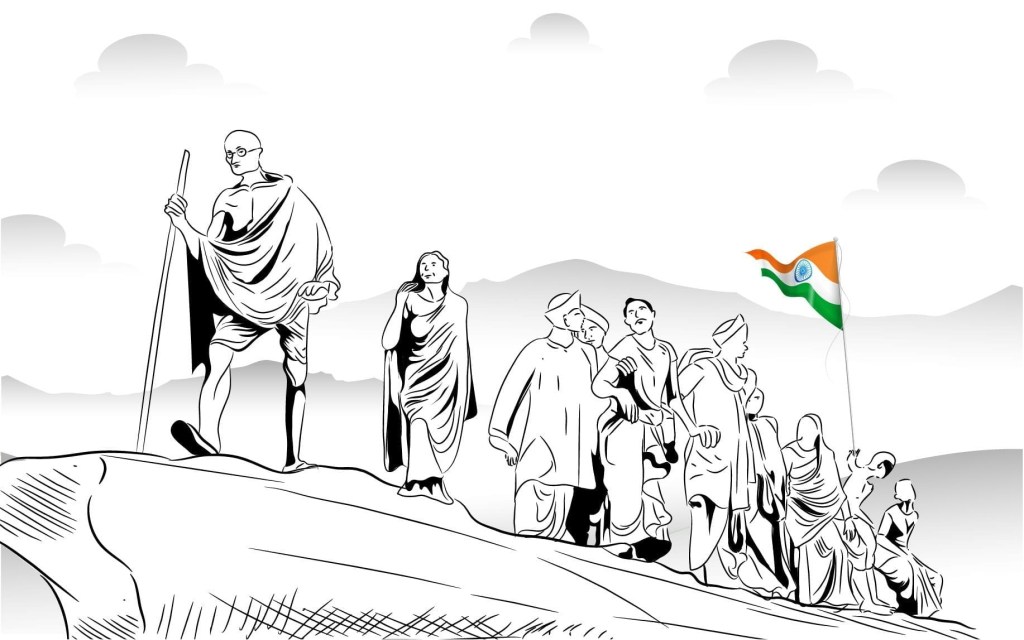
The late nineteenth century saw the emergence of Indian nationalism. Indians felt like one and they tried to overthrow the foreign rule. This led to the Indian freedom struggle and finally independence. Read to know about the exciting history of India’s struggle for independence
This Blog Include’s
- Foundation of Indian National Congress in 1885
- Partition of Bengal in 1905
- The Swadeshi Movement
- The split in The Congress (1907)
- Britisher’s policy towards INC
- Morley- Minto Reforms (1909)
- The Gadhar Movement
- The Home Rule Movement
- Champaran Movement in Bihar
- Ahmedabad Satyagraha in Gujrat
- Kheda Satyagraha in Gujrat
- Rowlatt Satyagraha
- Jallianwala Bagh Masscare (1919)
Non Cooperative Movement (1920)
- Khilafat Movement (1919-1924)
- Chauri Chaura Incident (1922)
- Bardoli Satyagraha in Gujrat (1928)
- The Boycott of Simon Commission (1927)
- Nehru Report 1928
- Poorna Swaraj or Total Independence Campaign (1929)
- Civil Disobidience Movement and Dandi March (1930)
- Gandhi Irwin Pact (1931)
- Round Table Conference (1930 -1932)
- The Communal Award
- Tripuri Dispute (1939)
- Cripps Mission (1942)
- Quit India Movement (1942)
- Shimla Conference (1945)
- Mountbatten Plan (1947)
- Indian Independence
- Foundation of Indian National Congress in (1885)
The indian National Congress was established when 72 delegates from all over the country met at Bombay in 1885.
Prominent Delegates like Dadabhai Naoraji, Firojshah Mehta, Badruddin Tayyabji, Surendranath Banerjee, Womesh Chandra Bannerjee and S Subramaniam Iyer.

The word Congress Was Taken from North America That Means Group of People’s
At first congress name was indian nation union. After the Advice of Dadabhai Naoraji its name was Kept As Indian National Congress
On 28 December 1885 Allen Octavian Hume founded the Indian National Congress at Bombay. The first session of INC was held At Gokuldas Tej prarap inter College Bombay
The First president of Indian National Congress was Womesh Chandra Bannerjee
Reasons behind the creation of Indian National Congress (INC)
Safety Valve Theory:There is a theory that Hume formed the Congress with the idea that it would prove to be a ‘safety valve’ for releasing the growing discontent of the Indians. To this end, he convinced Lord Dufferin not to obstruct the formation of the Congress.
The extremist leaders like Lala Lajpat Rai believed in the ‘safety valve’ theory. Even the Marxist historian’s ‘conspiracy theory’ was an offspring of the ‘safety valve’ notion.
Organization for expression of Indian Demands:Modern Indian historians dispute the idea of ‘safety valve’. In their opinion the Indian National Congress represented the urge of the politically conscious Indians to set up a national body to express the political and economic demands of the Indians. Historian Bipan Chandra observes early Congress leaders used Hume as a catalyst to bring together.
Major Objectives of INC
- A Pan India Organization: To found a democratic, nationalist movement through a pan India organization.
- Politicize and politically educate people: Congress aimed to increase awareness about the colonial exploitative policies the political rights of Indians. To this end congress focused on demanding increasing representation in councils, Indianization of civil services etc.
- Anti-colonialism: Develop and propagate an anti-colonial nationalist ideology; Promote friendly relations among nationalist political workers from different parts of the country.
- Forward looking political and economic programme: Formulate and present popular demands before the government with a view to unifying the people over a common economic and political programme.
- Promote Nationalism: Develop and consolidate a feeling of national unity among people irrespective of religion, caste or province
Wheat Crisis!
The Government of India announced a sudden ban on export of wheat on May 13,2022, a few days after Prime Minister Narendra Modi had stated that“at a time when the world is facing a shortage of wheat, the farmers of India have stepped forward to feed the world”
The Directorate General of Foreign Trade (DGFT) issued a notification banning exports of wheat with immediate effect to control price rise.
Even a day before the export ban came into effect, Government officials were looking out for possible export locations,indicating that there were no plans for control of wheat exports
The sudden turnaround in the export policy appears to be on account of fears that low public procurement would affect domestic food security.The system of public procurement has been in place since the mid 1960s, and has been the backbone of food policy in India
The restrictions would not apply in cases where prior commitments have been made by private traders through Letter of Credit as well as in situations where permission is granted by the government to other countries to meet their food security needs.
Present status of India’s wheat exports
- Major export countries:
- Bangladesh(55.9 percent)
- Sri Lanka(7.9 percent)
- UAE(6.9 percent)
- Indonesia(5.9 percent)
- Yemen(5.3 percent)
- Philippines(5.1 percent)
Export statistics: In the current financial year 2022-2023, the government estimates about 45 lakh metric tonnes of wheat to have been contracted for exports
- It has set a goal of exporting 10 million tons of the grain in 2022-23.
- Wheat production in India is expected to be lower than the earlier estimates.
- India exported 7 million tonnes(MT) of wheat in 2021-22 which is valued at $2.05 billion.
Out of total shipment around 50% of wheat was exported to Bangladesh in the last fiscal year.
Wheat
The wheat in India is largely a soft/medium hard, medium protein, white bread wheat, almost similar to U.S. hard white wheat
Wheat is a major cereal crop in India and is grown mainly in central and western India is typically hard, with high protein and high gluten content.
It is a Rabi Crop sown in October-December and harvested during April-June.
Temperature required: Between 23±3°C and for good tillering temperature should range between 16-20°C
Better variety of wheat is produced in areas having cool, moist weather during the major portion of the growing period followed by dry, warm weather to enable the grain to ripen properly.
Soil Type: Soils with a clay loam or loam texture, good structure and moderate water holding capacity are ideal for wheat cultivation
Wheat producing states in India: Uttar Pradesh, Punjab, Haryana, Madhya Pradesh, Rajasthan, Bihar and Gujarat.
Reasons for the sudden decision by the Government
- wheat production this year is feared to be lower than 100 million tonnes (mt) against initial estimates of a record 111.32 mt.
- Procurement by the Food Corporation of India (FCI) dropped by over 50 percent compared with last year.
Wheat price is increase in the wake of export demand triggered by the Russia-Ukraine war and soaring inflation
A sharp surge in global wheat prices that could have affected Indian consumers.
Fertilizer prices have more than trebled since the Russia-Ukraine war broke out. It will likely lead to lower sowing of wheat across the world and thus, the tight supply situation may continue into 2023.
Demand for India’s wheat expected to rise
- Wheat prices have been rising internationally on account of supply shortages due to the Russia-Ukraine war. The demand for Indian wheat has increased overseas.
- More countries are turning to India because of the competitive price, acceptable quality, availability of surplus wheat and geopolitical reasons.
While the existing importers are buying more, new markets have emerged for Indian wheat. Exports this fiscal year are expected to be almost 10 million tonnes worth $3 billion
Food Corporation of India (FCI)
● It is a Public Sector Undertaking, under the Department of Food & Public Distribution, Ministry of Consumer Affairs, Food and Public Distribution.
● FCI is a statutory body set up in 1965 under the Food Corporations Act 1964.
● It was established against the backdrop of a major shortage of grains, especially wheat.
● It has the primary duty to undertake purchase, store, move/transport, distribute and sell food grains and other foodstuffs.
Bhalia Variety of Wheat
● It is a variety of wheat that received GI certification in 2011.
● It has high protein content and is sweet in taste.
● The crop is grown mostly across the Bhal region of Gujarat which includes
● This variety is grown in rainfed conditions without irrigation.
Way Forward
- A well functioning PDS can control prices and offer relief to consumers. At the same time, procurement policy can and should offer a reasonable income to farmers
##Zidd

Class 10 Ncert chapter 1
Chemical Reactions and Equations
1. Why should a magnesium ribbon be cleaned before burning in air?
Magnesium ribbon should be cleaned before burning in air because Magnesium metal reacts with the atmospheric oxygen and forms Magnesium Oxide (MgO) layer which is a very stable compound. In order to prevent further reactions with Oxygen, it is therefore necessary to clean the ribbon by to remove the layer of MgO.
2Mg + O2 ———–> 2MgO
2. Write a balanced equation for the following chemical reactions.
i) Hydrogen + Chloride —-> Hydrogen chloride
ii) Barium chloride + Aluminium sulphate —-> Barium sulphate + Aluminium chloride
iii) Sodium + Water —-> Sodium hydroxide + Hydrogen
Solution
i) H2 + Cl2 → 2HCl
ii) 3BaCl2 + Al2(SO4)3 →3BaSO4 + 2AlCl3
iii) 2Na + 2H2O → 2NaOH + H2
3. Write a balanced chemical equation with state symbols for the following reactions
(i) Solutions of Barium chloride and Sodium sulphate in water react to give insoluble Barium sulphate and solution of Sodium chloride.
(ii) Sodium hydroxide solution in water reacts with hydrochloric acid solution to produce Sodium chloride solution and water
Solution
i) BaCl2 + Na2SO4 → BaSO4 + 2NaCl
ii) NaOH + HCl → NaCl + H2O
Question set 2
1. A solution of a substance ‘X’ is used for whitewashing
(i) Name the substance ‘X’ and write its formula.
(ii) Write the reaction of the substance ‘X’ named in (i) above with water
(i) The substance ‘X’ which is used in whitewashing is quick lime or Calcium Oxide and its formula is CaO.
(ii) CaO + H2O → Ca(OH)2
2. Why is the amount of gas collected in one of the test tubes in Activity 1.7 double of the amount collected in the other? Name this gasWhy is the amount of gas collected in one of the test tubes in Activity 1.7 double of the amount collected in the other? Name this gas
In activity 1.7, gas collected in one of the test tubes is double of the amount collected in the other because water gets hydrolysed to release H2 and O2 gas. Here, after electrolysis two molecules of Hydrogen and one molecule of oxygen gas is released, hence the amount of Hydrogen collected would be double than that of oxygen.
Question set 3
1. Why does the colour of copper sulphate solution change when an iron nail is dipped in it
Solution:
When an iron nail dipped in the copper sulphate solution, iron displaces copper from the copper sulphate because iron is more reactive than copper. Therefore the colour of the copper sulphate solution changes. The reaction is:
Fe + CuSO4 → FeSO4 + Cu
2. Give an example of a double displacement reaction other than the one given in Activity 1.10
Solution:
Reaction Between silver nitrate (AgNO3) and Sodium chloride (NaCl) is an example of double displacement reaction. During the reaction negative and positive ions trade positions as a result in the formation of white silver chloride precipitate. The chemical reaction is given below.
Ag+ + NO3– + Na+ + Cl– → AgCl + Na+ + NO3
3. Identify the substances that are oxidized and that are reduced in the following equation.
i) 4Na(s) + O2(g) → 2Na2O(s)
ii) CuO(s) + H2(g) → Cu(s) + H2O(l)
Solution:
The Sodium (Na) in the first equation is getting oxidized with the addition of Oxygen (O2) and the Copper (Cu) in the second equation is reduced due to the addition of Hydrogen (H2)
1. Which of the statements about the reaction below are incorrect?
2PbO(s) + C(s) → 2Pb(s) + CO2(g)
(a) Lead is getting reduced
(b) Carbon Dioxide is getting oxidised
(c) Carbon is getting oxidised
(d) Lead oxide is getting reduced
(i) (a) and (b)
(ii) (a) and (c)
(iii) (a), (b) and (c)
(iv) all
Solution:
(i) (a) and (b)
Explanation: (a) because Oxygen is being removed and (b) because the removed oxygen from Lead is added to the elemental Carbon
0
2. Fe2O3 + 2Al → Al2O3 + 2Fe
The above reaction is an example of a
- Combination reaction.
- Double displacement reaction.
- Decomposition reaction.
- Displacement reaction
Explanation: The Oxygen from the Ferrous oxide is getting displaced to the Aluminium metal to form Aluminium Oxide. In this reaction Aluminum is more reactive metal than Fe. Therefore Al will displace Fe from its oxide. This type of chemical reactions in which one of the elements displace another is called displacement reaction. Here less reactive metal is displaced by more reactive metal. Since one-time displacement is occurring, therefore, it is called a single displacement reaction
1
3. What happens when dilute hydrochloric acid is added to iron fillings? Tick the correct answer.
- Hydrogen gas and Iron chloride are produced.
- Chlorine gas and Iron hydroxide are produced.
- No reaction takes place.
- Iron salt and water are produced.
Solution:
- Hydrogen gas and Iron chloride are produced.
Explanation: The Chlorine from Hydrogen chloride is displaced by the Iron fillings to undergo the following reaction.
2HCl + Fe → FeCl2 + H2
4. What is a balanced chemical equation? Why should a chemical equation be balanced?
Solution:
A balanced equation is the one in which number of different atoms on both the reactant and product sides are equal. Balancing chemical equation is necessary for the reaction should obey The Law of Conservation of mass. Balancing the chemical equation has no defined method and is purely a trial and error attempt.
0
5. Translate the following statements into chemical equations and balance them.
(a) Hydrogen gas combines with nitrogen to form ammonia.
(b) Hydrogen sulphide gas burns in air to give water and sulphur dioxide.
(c) Barium chloride reacts with aluminium sulphate to give Aluminium chloride and a precipitate of barium sulphate.
(d) Potassium metal reacts with water to give potassium hydroxide and Hydrogen gas
Solution
(a) Unbalanced: H2 + N2 → NH3
Balanced: 3H2 + N2 → 2NH3
(b) Unbalanced: H2S + O2 → H2O + SO2
Balanced: 2H2S + 3O2 → 2H2O + 2SO2
(C)
Unbalanced:
BaCl2 + Al2(SO4)3 → AlCl3 + BaSO4
Balanced: 3BaCl2 + Al2(SO4)3 → 2AlCl3 + 3BaSO4
1
(d) Unbalanced: K + H2O → KOH + H2
Balanced: 2K + 2H2O → 2KOH + H2
6. Balance the following chemical equations.
(a) HNO3 + Ca(OH)2 → Ca(NO3)2 + H2O
(b) NaOH + H2SO4 → Na2SO4 + H2O
(c) NaCl + AgNO3 → AgCl + NaNO3
(d) BaCl2 + H2SO4 → BaSO4 + HCl
(a) 2HNO3 + Ca(OH)2 → Ca(NO3)2 + 2H2O
(b) 2NaOH + H2SO4 → Na2SO4 + 2H2O
(c) NaCl + AgNO3 → AgCl + NaNO3
(d) BaCl2 + H2SO4 → BaSO4 + 2HCl
 Education and World Affair