Sound :- sound is a form of Energy that is produced by producing vibrations of an object.
1.Sound Cannot Move through Vacuum
2. Sound Waves are Longitudinal Waves
Introduction to Sound
Introduction to waves
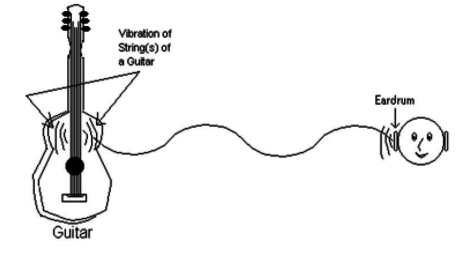
The sound is produced by vibrating objects.They travel from one place to another in the form of waves. Hence, the name sound waves.
Wave and particle motion of waves
Mechanical waves are waves that travel through a material medium.
It is of two types: depending on the direction of motion of the particle of the medium and the wave propagation:
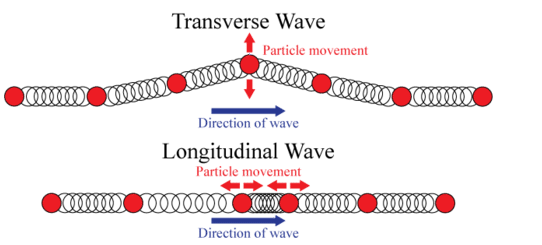
Transverse waves
Particle motion is to perpendicular the direction of wave motion.This type of wave is a mechanical wave called a transverse wave. E.g.: Light, or even Mexican wave in a stadium
Longitudinal waves
When the particles of the medium travel parallel to the direction of the wave motion by means of successive compression or rarefaction.It is also a mechanical wave.Example: a slinky
Sound Properties
Introduction to sound waves
Sound needs a medium to propagate. The matter or material through which sounds propagates is called a medium.
– Sound cannot travel in a vacuum. The moon does not have an atmosphere, hence, you can hear on the moon.
Sound can travel through Solid , Liquid or Gas
Solids have tightly packed particles in them and hence they allow fast propagation of sound through them as the vibrations can be carried easily from one particle to another.
Liquids have slightly loosely packed particles and hence it takes a little time for sound to travel in water or through a liquid.
Gases have completely loosely packed particles and hence sound takes the most time in travelling through the air.
Sounds by Humans
How do humans produce sound?
The sound produced in the voice box called larynx located at the upper end of the windpipe.2 vocal cords get stretched across in the voice box. Has a slit, through which air is forced out by the lungs.Muscles attached to vocal cords make it tight or loose.
Hearing
Human ear
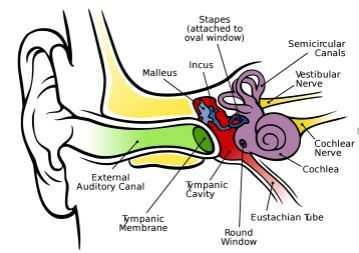
Outer ear = pinna: collects sound from the surroundings.Sound passes through a tube called an auditory canal.Eardrum (tympanic membrane) → vibrates when the sound incident.Vibrations are sent to the inner ear, from there it goes to the brain as signals via the auditory nerve.
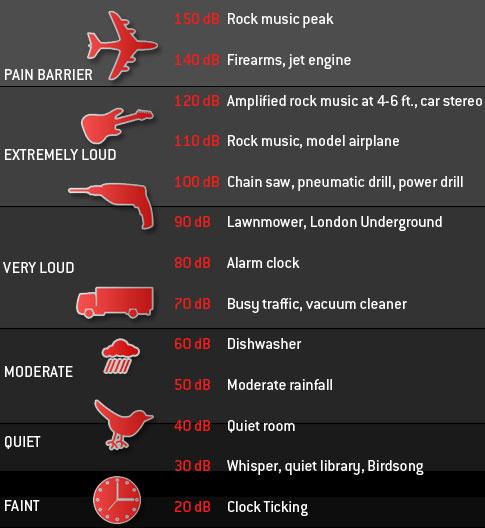
Noise level of 85 dB can damage the human ear.
Frequency:-
Frequency is measured number of oscillations per second.
It is measure in Hertz( Hz)
Amplitude:-
The number of molecules that a sound waves displace from mean position creates the amplitude of a medium.
The loudness of a sound
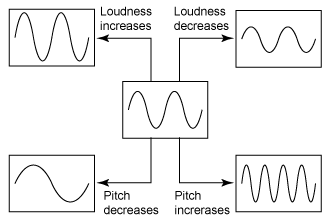
The loudness of a sound depends upon the amplitude of the sound.
The higher the amplitude, the higher is the displacement of the particles and the higher is the loudness of the sound.
The loudness of the sound is directly proportional to the square of its amplitude.
The SI unit for measuring the loudness of a sound in decibels (dB).
Pitch of the sound
Every person has a different sound quality.
Also, every musical instrument vibrates to produce a different kind of sound. This quality of sound is characterized by its Different quality of sounds may have same pitch and loudness.
The pitch of a sound depends upon the frequency of the sound wave.
The pitch would be higher if the frequency of the sound is high.
Sounds that can be heard by human ears are called audible sounds. The range of audible sounds is from 20 Hz to 20 KHz.
Sounds that cannot be heard by human ears are called inaudible sound. Any sounds having a frequency less than 20 Hz or greater than 20 KHz are categorized as inaudible sounds
Infrasound
The sounds having a frequency range below 20 hertz are called infrasound.
Infrasound cannot be heard by humans.
Animals like giraffe, rhinoceros and whales use infrasound to communicate.
Ultrasound
The sound waves having a frequency range above 20 kilohertz are called ultrasounds
Having too high frequency, they cannot be heard by human beings as well
Bats, dogs and cats use ultrasounds to communicate.
Ultrasounds can be used for various purposes such as identifying abnormalities in the human body or calculating distances under the water through SONAR
Thank you
Satish Kumar Seth
 Education and World Affair