Chapter :1 Rational Number
Rational Number:-
A Number That can be Represented As P/Q form where Q≠ 0
Example= 1/2, 3/4 , 0, 2, -1/3
- Rational Number contains Whole Number, Natural Number, Integers
- π is an Irrational Number
Irrational Number
Any real number that cannot be expressed as the P/Q form
Example :- π , √11, √21
Tpyes of Rational Number
There are different types of rational numbers. We shouldn’t assume that only fractions with integers are rational numbers. The different
types of rational numbers are:
- integers like -2, 0, 3 etc.
- fractions whose numerators and denominators are integers like 3/7, -6/5, etc.
- terminating decimals like 0.35, 0.7116, 0.9768, etc.
- non-terminating decimals with some repeating patterns (after the decimal point) such as 0.333…, 0.141414…, etc. These are popularly known as non-terminating repeating decimals
How to Identify Rational Number
In each of the above cases, the number can be expressed as a fraction of integers. Hence, each of these numbers is a rational number. To find whether a given number is a rational number, we can check whether it matches with any of these conditions:
- We can represent the given number as a fraction of integers
- We the decimal expansion of the number is terminating or non-terminating repeating.
- All whole numbers are rational numbers
Rational Number In Form Of Decimal
Decimal Numbers Also come under Rational Number For example 0.3 Because we can Write 0.3 as 3/10 which is A Rational Number
Is 0 a Rational Number…?
Yes 0 is a Rational Number Becuase it can be written As 0/1 which is A Rational Number
Properties Of Rational Number
General Properties of Rational Numbers Like
Closure property, Associative property, Commutative property, Distributive property, identity, Inverse etc.
Closure Property
Closure property with reference to Rational Numbers
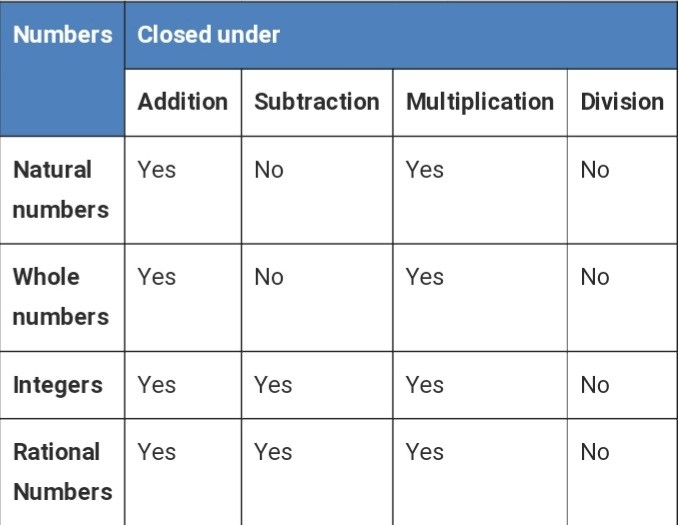
Closure property states that if for any two numbers a and b, a∗b is also a rational number, then the set of rational numbers is closed under addition.
∗ represents +,−,×
Associative Property
A set of numbers is said to be associative for a specific mathematical operation if the result obtained when changing grouping (parenthesizing) of the operands does not change the result.
Addition Associatice Property
For exg:- a+(b+c) = c+(a+b)
Subtraction Associative property
Does not Follow
Multiplicative Associative Property
For exg:- a×(b×c) = c×(a×b)
Divisional Associative Property
Does not follow
Commutative Property
The commutative property states that the numbers on which we operate can be moved or swapped from their position without making any difference to the answer. The property holds for Addition and Multiplication, but not for subtraction and division. Let’s see
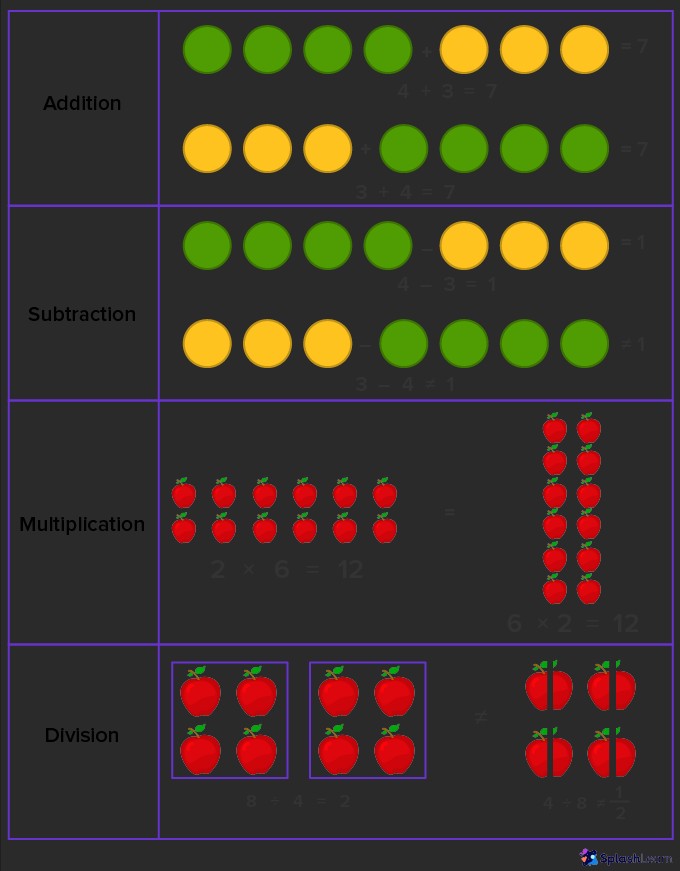
The above examples clearly show that the commutative property holds true for addition and multiplication but not for subtraction and division. So, if we swap the position of numbers in subtraction or division statements, it changes the entire problem.
So, mathematically commutative property for addition and multiplication looks like this
Commutative Property of Addition:
a + b = b + a; where a and b are any 2 whole numbers
Commutative Property of Multiplication:
a × b = b × a; where a and b are any 2 nonzero whole numbers
Distributive property
If three numbers are a, b and c then a×(b+c)=ab+ac , a×(b-c) = ab-ac
Multiplicative Inverse
Multiplication Inverse Means A fraction and Multiply the Fraction By Reciprocal Of that Fraction So the Result Is 1. For exg
For Fraction a/b the Multiplicative will be b/a so that a/b ×b/a gives 1
Additive Inverse
Additive inverse means A fraction and Add the Same Fraction with opposite of that sign so the result is 0. For exg
a/b+(-a/b) =a/b-a/b =0
Additive Identity
0 is know as Additive Identity beacuse 7+0 =0+7 thus 7=7 No change in Value
Multiplicative Identity
1 is known as multiplicative Identity because 7×1 =1×7 =7=7 the Value Not change
Standard form of Rational Number
Standard form of rational number Means There is No Common Between Numerator and Denominator except 1. For exg
Standard form of 16/8 is 2/1
 Education and World Affair