Important Questions & Numericals
Very Short Answer Type Questions
Q1. What happens when a ray of light falls normally on the surface of a plane mirror..?
When a ray of light falls normally (or perpendicularly) on the surface of a plane mirror, this means the angle of incidence is 0o. From the second law of reflection, we know that angle of incidence is equal to the angle of reflection, so the angle of reflection will also be zero. Thus, the light ray will be reflected back along the same path.
Q2. A ray of light is incident on a plane mirror at an angle of 30 degrees. What is the angle of reflection?
We know from the laws of reflection that the angle of incidence is equal to the angle of reflection. Therefore, angle of reflection will be equal to 30 degrees.
Q3. A ray of light strikes a plane mirror at an angle of 40 degrees to the mirror surface. What will be the angle of reflection?
The angle to the mirror surface = 40 degrees
The angle of incidence = 90-40 = 50 degrees
Therefore, angle of reflection = 50 degrees from laws of reflection
Q4. A ray of light is incident normally on a plane mirror. What will be the:
a) angle of incidence
b) angle of reflection?
a) 0 degree
b) 0 degree
Q5. What type of image is formed:
a) in a plane mirror
b) on a cinema screen
a) Virtual image
b) Real image
Q6. What kind of mirror is required for obtaining a virtual image of the same size as the object
Plane mirror is required
Q7. What is the name of the phenomenon in which the right side of an object appears to be the left side of the image in a plane mirror?
This phenomenon is known as lateral inversion
Q9. If an object is placed at a distance of 10cm in from of a plane mirror, how far would it be from its image?
The image is formed behind the mirror at the distance which is equal to the distance at which the object is placed.
Given,
Distance between object and mirror = 10cm
Distance between mirror and image = 10cm
Therefore, the distance between object and image = 20cm
Q10. Which property of light makes a pencil cast a shadow when it is held in front of a light source
Light travels in a straight line
Q11. The image seen in a plane mirror cannot be formed on a screen. What name is given to this type of image?
Such images are known as virtual images.
Q12. Fill in the blanks:
When light is reflected, the angles of incidence and reflection are …
Answer:
Equal
Q13. State whether the following statement is true or false:
A student says that we can see an object because light from our eyes is reflected back by the object.
Answer:
False.
Q14. Where is the image when you look at something in a mirror?
Answer:
At the back side of the mirror
Q15. A ray of light strikes a plane mirror such that its angle of incidence is 30 degree. What angle does the reflected ray make with the mirror surface?
Angle of incidence = 30 degrees
We know that, angle of incidence = angle of reflection from laws of reflection.
Therefore, angle of reflection = 30 degree
Short Answer Type Questions
Q16. What is the difference between a real image and a virtual image?
Answer:
The difference between a real image and a virtual image is that real image can be obtained on the screen while the virtual image cannot be obtained on the screen.
Example of real image: image formed on the screen in cinemas.
Example of virtual image: image formed by the plane mirror
Q17. The letter F is placed in front of a plane mirror:
a) How would its image look when seen in a plane mirror?
b) What is the name of the phenomenon involved?

b) Lateral inversion
Q18. What is lateral inversion? Explain by giving a suitable example
When an object is placed in front of a plane mirror, the image obtained on the appears to on that opposite that is right side appears to be on the left side. This change in the sides of an object and its mirror image is known as lateral inversion
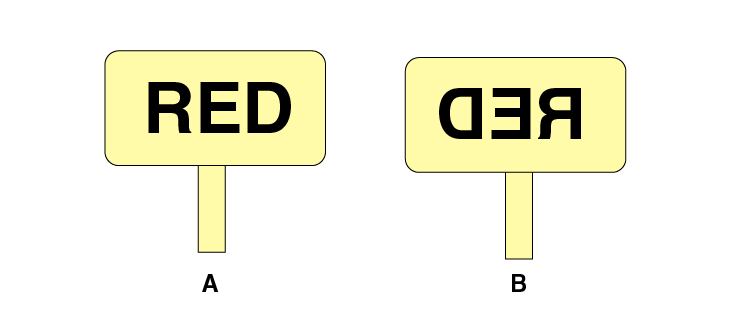
Q19. Write the word AMBULANCE as it would appear when reflected in a plane mirror. Why sometimes written in this way on the front of an ambulance?

Ambulance is written like the above because when it appears on the rear-view mirror of the vehicle in front can read it the right way because of lateral inversion and make way for it
Q20. What are the important difference between looking at a photograph of your face and looking at yourself in a plane mirror?
The difference between looking at a photograph and looking at yourself is that of lateral inversion. But this doesn’t happen in photographs
Q21. a) A wall reflects light and a mirror also reflects light. What difference is there in the way they reflect light?
b) Which type of reflection of light leads to the formation of images?
a) A wall has a rough surface therefore, when a parallel beam of light falls on it the reflection would be diffused reflection while the surface of the mirror is smooth and the reflection would be regular reflection.
b) Regular reflection.
Q22. What is the difference between regular reflection of light and diffuse reflection of light? What type of reflection of light takes place from:
a) a cinema screen
b) a plane mirror
c) a cardboard
d) still water surface of a lake
Answer:
In regular reflection, the light beams travel parallel to each other and gets reflected in a similar manner while in diffused reflection, the parallel beam of light gets reflected in all the directions.
a) Regular reflection
b) Regular reflection
c) Diffuse reflection
d) Regular reflection
Q23. What can you see in a completely dark room? If you switch on an electric bulb in this dark room as a light source, explain how you could see:
a) the electric bulb
b) a piece of white paper
When we are in a completely dark room, we cannot see anything as there is no light.
a) We can see the electric bulb emitting light
b) White paper is visible it reflects the light back that is falling from the electric bulb
Q24. a) A boy with a mouth 5cm wide stands 2m away from a plane mirror. Where is his image and how wide is the image of his mouth?
b) The boy walks towards the mirror at a speed of 1m/s. At what speed does his image approach him?
Answer:
a) The width of the image of the mouth of the boy is 5cm and the image is formed at 2m behind the mirror.
b) The speed of the boy approaching the mirror will be the same as the image approaching = 1m/s
therefore, the speed = 2+2 = 4 m/s
Q25. a) An extended object in the form of an arrow pointing upward has been placed in front of a plane mirror. Draw a labelled ray diagram to show the formation of its image.
b) State the uses of plane mirror
b) Uses of plane mirrors:
i) It is used for making periscopes.
ii) Used in homes to see ourselves.
iii) Can be used a decorative piece
 Education and World Affair