What is QUAD…??
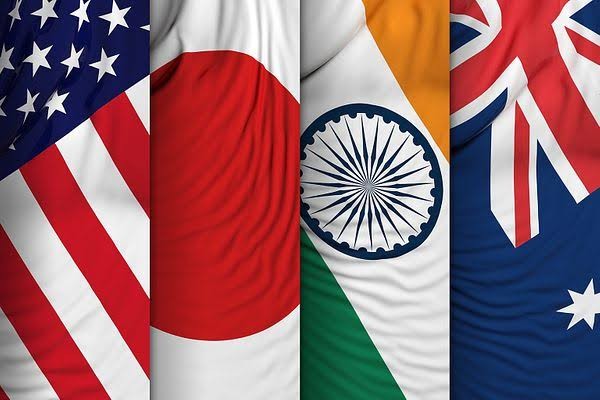
The Quadrilateral Security Dialogue (QSD), colloquially the Quad (sometimes erroneously written QUAD despite not being an acronym), is a strategic security dialogue between Australia, India, Japan, and the United States that is maintained by talks between member countries.
The Quad is a diplomatic network of four countries committed to supporting a free and open Indo-Pacific that is inclusive and resilient. It complements our other bilateral, regional and multilateral cooperation, including with ASEAN member states and Pacific partners.
Why was QUAD Formed ….?
Quad Formation: It was initiated in 2007 by Shinzo Abe, Japanese Prime Minister with the support of the Australian PM Johan Howard, the US Vice-President Dick Cheney and Man Mohan Singh, PM of India. It was aligned with a joint military exercise, titled Exercise Malabar
QUAD Significance
Details about why Quad is significant are given below:
- Quad has emerged from a mere security co-operation into the Quad Framework that includes: supply chain initiatives and collaboration in the emergence of critical technologies.
- India is central to the Quad framework visible from the term “Indo-Pacific” and has got a chance to showcase its capabilities to other nations.
- A major dialogue to counter the assertive role and dominance of China in the Indo-Pacific region and oppose them. It can influence other South-East nations for the same.
Quad Nations And China
USA: USA had followed a policy to contain China’s increasing influence in East Asia. Therefore, USA sees the coalition as an opportunity to regain its influence in the Indo-Pacific region.
The US has described China, along with Russia, as a strategic rival in its National Security Strategy, National Defence Strategy and the Pentagon’s report on Indo-Pacific Strategy.
Australia: Australia is concerned about China’s growing interest in its land, infrastructure and politics, and influence on its universities.
- Taking into account its overwhelming economic dependence on China for prosperity, Australia has continued its commitment to a Comprehensive Strategic Partnership with China
Japan: In the last decade, Japan has expressed concerns related to China’s territorial transgression in the region.
- Trade volume with China remains the key lifeline to the Japanese economy, where net exports contributed exactly one-third of Japan’s economic growth since the beginning of 2017.
Japan has also agreed to involve in the Belt and Road Initiative by participating in infrastructure programs in third country. In this way, Japan can mitigate Chinese influence in those countries while improving relations with China.
India: In recent years, China’s violation of international norms, particularly its construction of military facilities on reclaimed islands in the South China Sea, and its growing military and economic power, pose a strategic challenge to India.
- Considering China’s strategic importance, India is carefully balancing China on one hand and the US on the other, by remaining committed to strategic autonomy to China, which has generally proved reassuring to China.
- India has also not permitted Australia to participate in Malabar Trilateral Maritime exercises between India, US and Japan, concerned about what message it would send to China, which is wary of the exercise.
- The recent Mamallapuram summit between President Xi Jinping and PM Modi is a positive development, valued by both sides as key to giving strategic guidance to stakeholders on both sides
Challenges
China’s Territorial Claims: China claims that it has historical ownership over nearly the entire region of South China Sea, which gives it the right to manufacture islands. However, the International Court of Arbitration rejected the claim in 2016
China’s Closeness to ASEAN: The ASEAN countries also have a well-knit relationship with China. The Regional Cooperation Economic Partnership (RCEP) is a recent example of China’s increasing influence over ASEAN nations
Economic Power of China: Considering the economic might of China and the dependence of Quad nations like Japan and Australia on China, the Quad nations cannot afford to have strained relations with it.
Convergence among Quad Nations: The nations in the Quad grouping have different aspirations, aims at balancing their own interest. Therefore, coherence in the vision of Quad nation as a grouping is absent.
 Education and World Affair