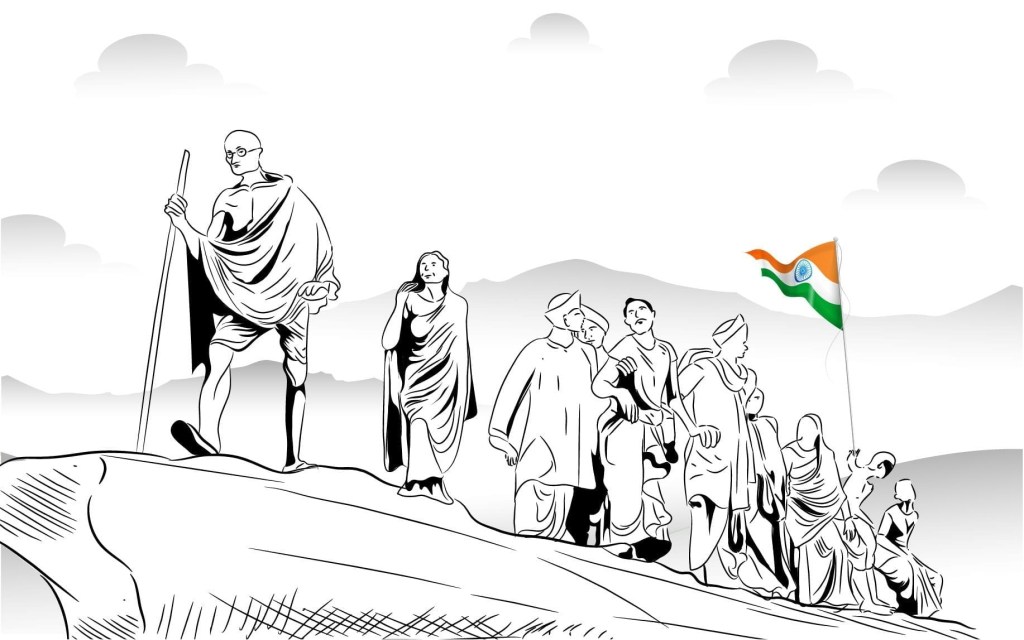
The late nineteenth century saw the emergence of Indian nationalism. Indians felt like one and they tried to overthrow the foreign rule. This led to the Indian freedom struggle and finally independence. Read to know about the exciting history of India’s struggle for independence
This Blog Include’s
- Foundation of Indian National Congress in 1885
- Partition of Bengal in 1905
- The Swadeshi Movement
- The split in The Congress (1907)
- Britisher’s policy towards INC
- Morley- Minto Reforms (1909)
- The Gadhar Movement
- The Home Rule Movement
- Champaran Movement in Bihar
- Ahmedabad Satyagraha in Gujrat
- Kheda Satyagraha in Gujrat
- Rowlatt Satyagraha
- Jallianwala Bagh Masscare (1919)
Non Cooperative Movement (1920)
- Khilafat Movement (1919-1924)
- Chauri Chaura Incident (1922)
- Bardoli Satyagraha in Gujrat (1928)
- The Boycott of Simon Commission (1927)
- Nehru Report 1928
- Poorna Swaraj or Total Independence Campaign (1929)
- Civil Disobidience Movement and Dandi March (1930)
- Gandhi Irwin Pact (1931)
- Round Table Conference (1930 -1932)
- The Communal Award
- Tripuri Dispute (1939)
- Cripps Mission (1942)
- Quit India Movement (1942)
- Shimla Conference (1945)
- Mountbatten Plan (1947)
- Indian Independence
- Foundation of Indian National Congress in (1885)
The indian National Congress was established when 72 delegates from all over the country met at Bombay in 1885.
Prominent Delegates like Dadabhai Naoraji, Firojshah Mehta, Badruddin Tayyabji, Surendranath Banerjee, Womesh Chandra Bannerjee and S Subramaniam Iyer.
The word Congress Was Taken from North America That Means Group of People’s
At first congress name was indian nation union. After the Advice of Dadabhai Naoraji its name was Kept As Indian National Congress
On 28 December 1885 Allen Octavian Hume founded the Indian National Congress at Bombay. The first session of INC was held At Gokuldas Tej prarap inter College Bombay
The First president of Indian National Congress was Womesh Chandra Bannerjee
Reasons behind the creation of Indian National Congress (INC)
Safety Valve Theory:There is a theory that Hume formed the Congress with the idea that it would prove to be a ‘safety valve’ for releasing the growing discontent of the Indians. To this end, he convinced Lord Dufferin not to obstruct the formation of the Congress.
The extremist leaders like Lala Lajpat Rai believed in the ‘safety valve’ theory. Even the Marxist historian’s ‘conspiracy theory’ was an offspring of the ‘safety valve’ notion.
Organization for expression of Indian Demands:Modern Indian historians dispute the idea of ‘safety valve’. In their opinion the Indian National Congress represented the urge of the politically conscious Indians to set up a national body to express the political and economic demands of the Indians. Historian Bipan Chandra observes early Congress leaders used Hume as a catalyst to bring together.
Major Objectives of INC
- A Pan India Organization: To found a democratic, nationalist movement through a pan India organization.
- Politicize and politically educate people: Congress aimed to increase awareness about the colonial exploitative policies the political rights of Indians. To this end congress focused on demanding increasing representation in councils, Indianization of civil services etc.
- Anti-colonialism: Develop and propagate an anti-colonial nationalist ideology; Promote friendly relations among nationalist political workers from different parts of the country.
- Forward looking political and economic programme: Formulate and present popular demands before the government with a view to unifying the people over a common economic and political programme.
- Promote Nationalism: Develop and consolidate a feeling of national unity among people irrespective of religion, caste or province
 Education and World Affair